



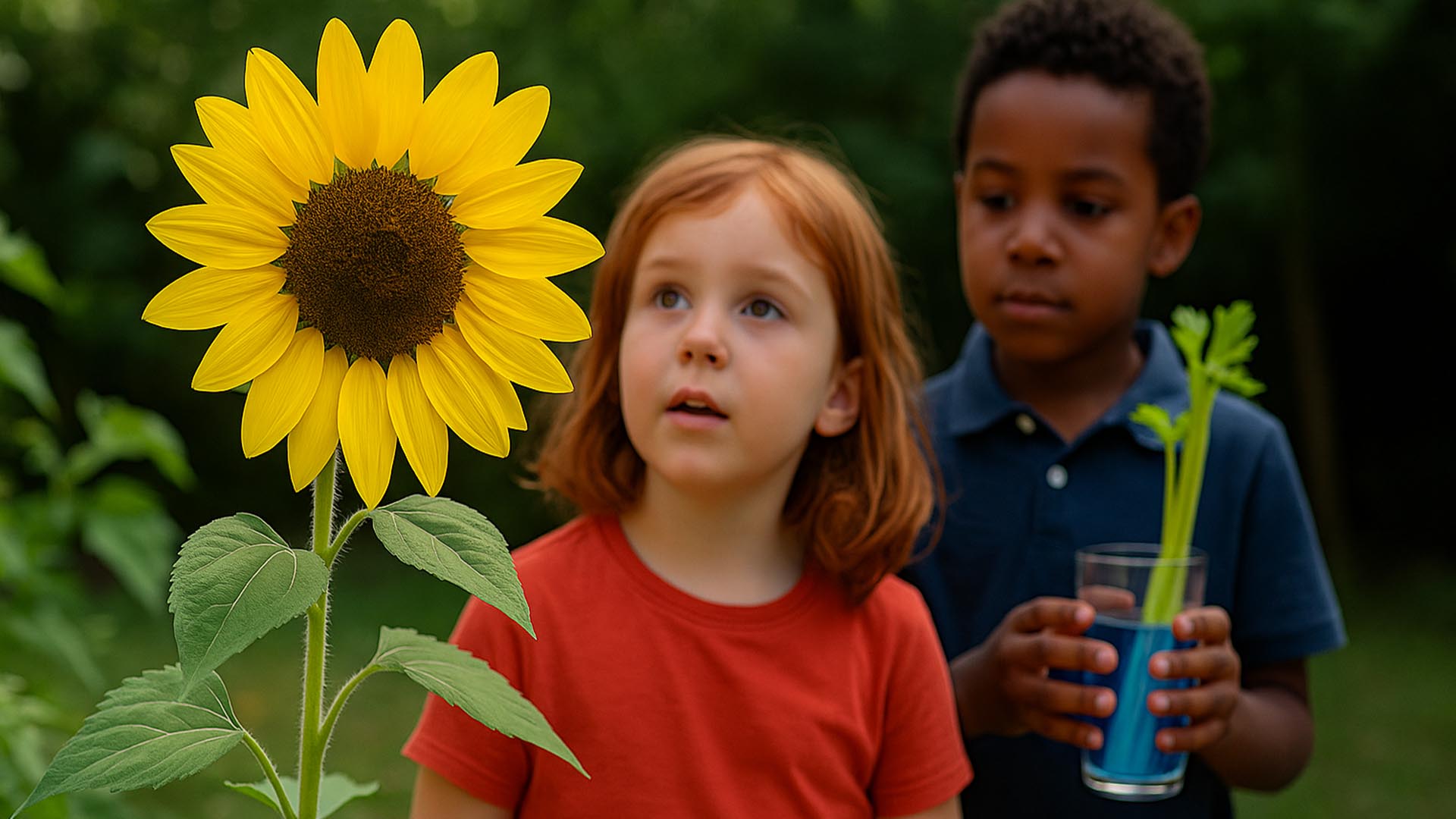

Welcome, young scientists! Have you ever wondered how plants grow so tall and strong without ever going to the grocery store? The answer is a real-life superpower called photosynthesis! It's a big word for a simple, amazing process where plants make their own food.
Think of a plant as a tiny, super-efficient chef. It doesn't need a stove or an oven. Instead, it uses three simple ingredients: sunlight, water, and air (specifically, a gas called carbon dioxide). With these, it cooks up a sweet sugar that gives it energy to grow, and as a bonus, it releases the fresh air we need to breathe!
The Three Main Ingredients for Plant Food
Photosynthesis is a team effort involving three key parts of the plant and three key ingredients from nature. Let's explore them!
The Role of Sunlight: The Plant's Energy Source
Just like you need energy to run and play, plants need energy to grow. They get this energy from the sun. The leaves of the plant are perfectly designed to catch as much sunlight as possible.
"Sunlight is the engine that drives almost all life on Earth, and photosynthesis is the key to unlocking that energy for plants."
The plant uses the light energy to power the whole food-making process. Without the sun, the plant's kitchen is closed!
Water and Nutrients: Drinking Through the Roots
Plants are very thirsty! They use their roots to soak up water from the soil. This water travels all the way up the stem to the leaves. The water also carries important nutrients from the soil, which are like the plant's vitamins.
Did you know that the water travels through tiny tubes inside the plant, a bit like straws? This is how every part of the plant gets what it needs. You can learn more about how water moves in plants from this great resource on plant biology for kids (link to a credible external source like a university extension or educational site, e.g., https://www.kidsgardening.org/learn/how-plants-drink/ ).
Carbon Dioxide: Breathing in the Air
The final ingredient comes from the air around us. It's a gas called carbon dioxide. When you breathe out, you release carbon dioxide, and guess what? Plants love it! They take it in through tiny little holes on their leaves called stomata.
It's a wonderful trade: we breathe out what plants need, and plants give us back oxygen, which is the fresh air we need to breathe in! This is why trees and plants are so important for our planet.
The Secret Ingredient: Chlorophyll
Have you noticed that most plants are green? That green color comes from a special substance inside the leaves called chlorophyll. Chlorophyll is the true magic maker! It's what captures the sunlight and starts the whole process of turning water and carbon dioxide into food (sugar) and oxygen.
Chlorophyll is so important that it's often called the plant's solar panel. It absorbs the red and blue light from the sun, but it reflects the green light, which is why we see the leaves as green!
Fun Photosynthesis Experiment: The Celery Color Change
You can see how plants drink water and nutrients with a simple experiment!
1.What you need: A stalk of celery (with leaves), a glass of water, and some food coloring (red or blue works best).
2.What to do: Fill the glass with water and add a few drops of food coloring. Place the celery stalk in the colored water.
3.What happens: Wait a few hours or overnight. You will see the colored water travel up the celery stalk and into the leaves! This shows how the plant moves water from its roots (or the bottom of the stalk) to its leaves.
Try this at home and watch the magic happen!
Q&A for Young Scientists
Q: Why is photosynthesis important for me?
A: Photosynthesis is super important because it makes the oxygen you breathe! It also makes the food that plants eat, and since we eat plants (like fruits and vegetables) or animals that eat plants, it's the start of almost all food chains on Earth.
Q: What is the food that plants make?
A: The food that plants make is a type of sugar called glucose. They use this sugar for energy to grow bigger and stronger.
Q: Can plants do photosynthesis at night?
A: No, plants need sunlight to do photosynthesis. However, they use the food they made during the day to grow and live at night.
Q: What is the green stuff in leaves called?
A: The green stuff is called chlorophyll. It's the part of the plant that catches the sunlight.
Sources
•NASA Climate Kids: What is Photosynthesis?
•National Geographic Kids: Plants
•The Science of Plants: A Children's Guide
•Credible Source on Plant Biology for Kids (e.g., University Extension)



0 Comments