


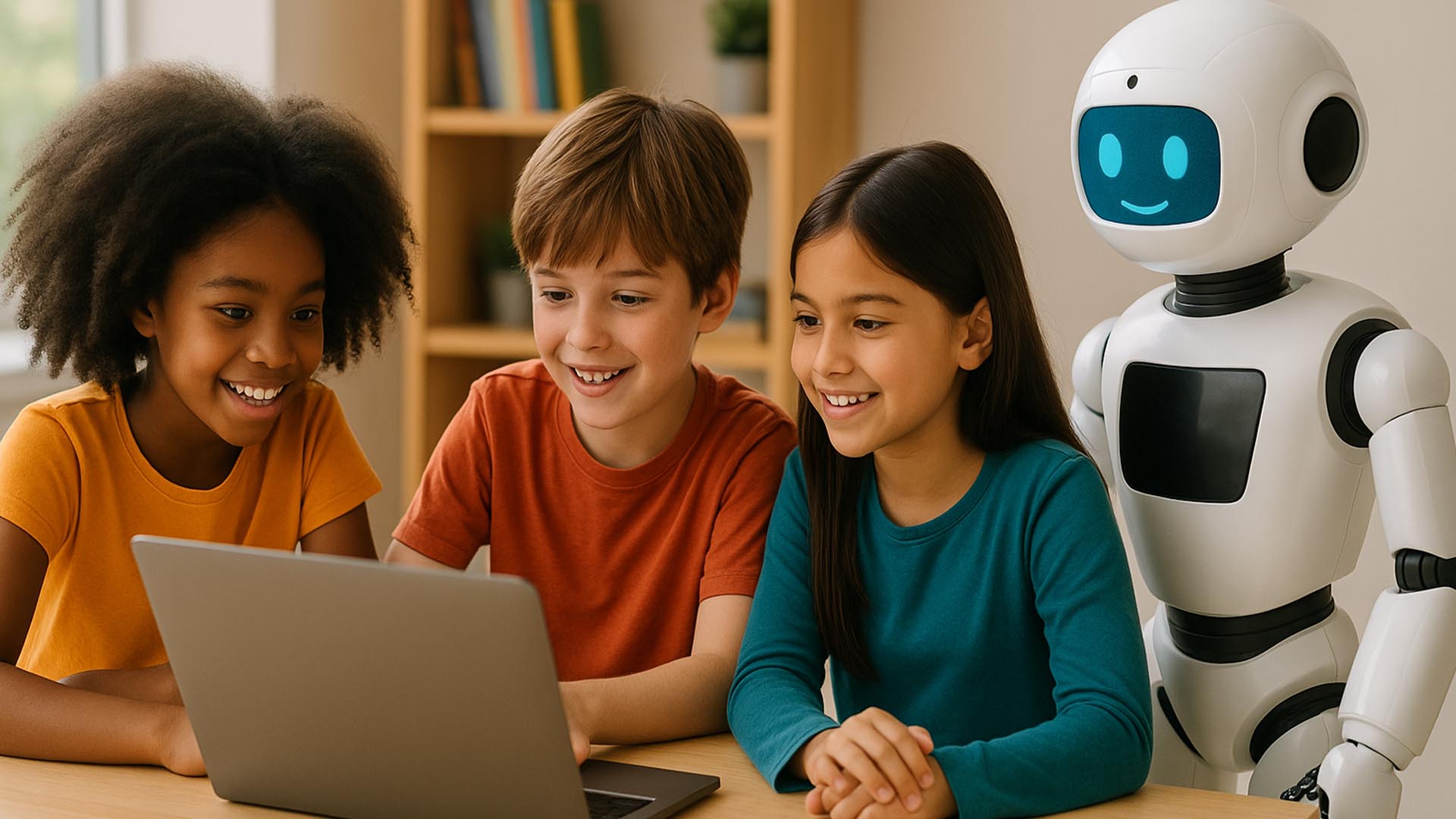
Have you ever asked a smart speaker to play your favorite song? Or seen a video game character that seems to learn how you play? If so, you’ve met Artificial Intelligence, or AI! Think of AI as a robot sidekick—a computer program that can learn, solve problems, and make decisions, just like a human brain.
AI is becoming a big part of our world, and it’s important for kids to understand how it works and how to use it safely 1.
Where Does AI Live? (AI in Your Daily Life)
AI isn't just in science fiction movies; it's all around you!
•Smart Phones and Tablets: AI helps your phone recognize your face, suggests the next word you might type, and organizes your photos.
•Video Games: AI controls the characters that aren't being played by a person (the "non-player characters" or NPCs), making them seem real and challenging.
•Online Shopping: AI recommends toys or books you might like based on what you’ve looked at before.
•Learning Tools: AI can help teachers create personalized quizzes and lessons just for you!
How Does AI Learn? (The Magic of Data)
AI learns in a way that’s similar to how you learn—by seeing lots and lots of examples, which we call data.
Imagine you want to teach a computer to recognize a cat. You show it thousands of pictures of cats: big cats, small cats, fluffy cats, and sleek cats. The computer looks for patterns and rules. Soon, when it sees a brand new picture, it can say, "That's a cat!"
This process is called machine learning, and it’s what makes AI so smart.
The Super-Important Rules of Safe AI (Ethics and Safety)
Just like any powerful tool, we need to use AI responsibly. The United Nations Children's Fund (UNICEF) has created guidelines to make sure AI is safe for kids 2.
Here are the Golden Rules for using AI:
1.Be a good teacher: The data we use to train AI must be fair and not biased. If we only show an AI pictures of one kind of dog, it won't recognize other kinds!
2.Protect your privacy: Never share personal information like your full name, address, or school with an AI or a robot.
3.Check the facts: Sometimes AI can make mistakes or "hallucinate" (make up false information). Always double-check important facts with a grown-up or a reliable source.
As one expert notes:
"Concerns with AI in education include privacy and security issues, bias in algorithms that can affect educational outcomes..." 3
This is why we must always be smart and careful when using AI tools. AI is a fantastic tool, but your brain is still the best!
Q&A: Your AI Questions Answered
Q: Can AI write my homework for me? A: AI can help you brainstorm ideas and get started, but your teacher wants to see your thinking and your effort. Using AI to do all your homework is like using a remote control to play a video game—you don't learn anything yourself! Use AI as a helper, not a substitute.
Q: Is AI a robot? A: Not always! AI is the brain or the computer program. A robot is the body—the physical machine that the AI can control. Many AIs, like the one that suggests videos to you, don't have a physical robot body at all!
Q: How can I learn more about AI? A: You can explore kid-friendly coding websites, ask your parents to find books about AI, or even try simple programming to see how computers follow instructions! Learning to code is like learning the secret language of AI.
Sources
[1] Artificial Intelligence and the Future of Teaching and Learning. U.S. Department of Education.
[2] Policy guidance on AI for children. UNICEF.
[3] AI in Schools: Pros and Cons. University of Illinois College of Education.



0 Comments