


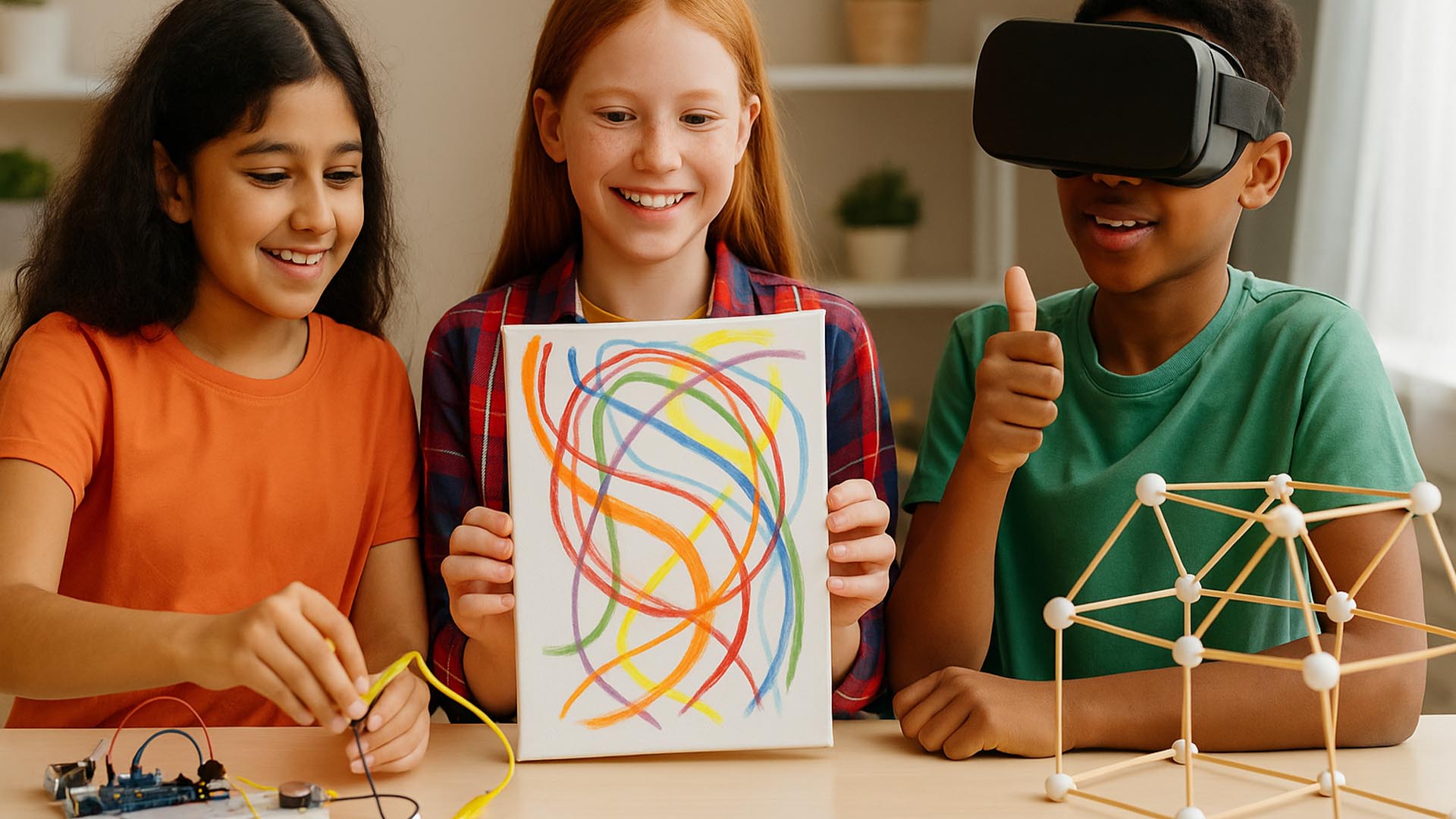
Imagine a world where you don't just learn about science, but you also get to paint, build, and design. That's the wonderful world of STEAM! It's an exciting way to learn that mixes five super-important subjects: Science, Technology, Engineering, Art, and Mathematics.
For a long time, people talked about STEM (without the A), but educators realized that creativity and design are key to solving real-world problems, so they added the "A" for Art [1].
This interdisciplinary approach means that instead of learning each subject separately, you see how they all work together, just like they do in real life! It’s all about making learning connected and super relevant [1].
What Each Letter in STEAM Really Means
Each letter in STEAM is a doorway to a new adventure:
S is for Science: Exploring the World Around Us
Science is all about asking "Why?" and "How?" It's the study of the natural world, from tiny atoms to giant galaxies. In STEAM, you might use science to understand why a bridge needs to be strong or how a robot moves.
T is for Technology: The Tools We Use
Technology isn't just about computers and phones; it's any tool or invention that helps us solve a problem. In a STEAM project, technology could be a simple lever, a coding program, or even a digital camera. Learning about technology helps you become a creator, not just a consumer [1].
E is for Engineering: Building and Designing
Engineers are the ultimate problem-solvers! They design, build, and test things to make our lives better. When you build a tower out of blocks or design a paper airplane, you're being an engineer. STEAM projects often involve hands-on engineering challenges.
A is for Art: Creativity and Thought
The "A" is the secret ingredient! Art includes visual arts, design, music, and drama. It brings creativity, imagination, and human-centered thinking to the mix [1]. Art helps you think outside the box, make things look good, and consider how people will use your invention. Without art, a brilliant invention might be boring or hard to use!
M is for Mathematics: The Language of the Universe
Math is the language used in all the other subjects. It helps you measure, count, and calculate. Whether you're figuring out the perfect angle for a ramp or measuring ingredients for a science experiment, math is your trusty sidekick.
The Superpowers You Gain from STEAM
STEAM education is more than just fun; it gives you amazing skills that will help you succeed in school and in any future job [2].
•Critical Thinking: Because STEAM projects often have many possible solutions, you learn to look at a problem from different angles and decide on the best approach. This is called critical thinking [1].
•Soft Skills: You get to practice important "soft skills" like working in a team, listening to others, and managing your time. Many STEAM tools, like modular robotic kits, are designed for collaboration [1].
•Future-Ready: The jobs of the future will need people who can mix technology with creativity. By learning STEAM now, you are preparing for a world that needs your unique skills [1].
"STEAM education develops children's critical thinking skills. Because STEAM projects are in their core interdisciplinary, they allow children to look at them from different perspectives." [1]
Q&A (Questions and Answers)
Q: What is the main difference between STEM and STEAM? A: The main difference is the "A" for Art. STEM focuses on Science, Technology, Engineering, and Math. STEAM adds Art to encourage creativity, design, and human-centered problem-solving, making the learning more interdisciplinary and reflective of real life [1].
Q: Can I do STEAM activities at home? A: Absolutely! You can try building a bridge out of spaghetti and marshmallows (Engineering & Math), creating a colorful chemical reaction with baking soda and vinegar (Science & Art), or even coding a simple game (Technology & Math). The most important part is to have fun and be creative!
Q: Why is STEAM important for my future job? A: The world is changing fast, and future jobs will need people who can use both technical skills (STEM) and creative skills (Art) to invent new things and solve complex problems. STEAM skills are in high demand and can open many doors for your career [1].
Sources
1.Robo Wunderkind: What is STEAM education and why is it so essential for children?



0 Comments