



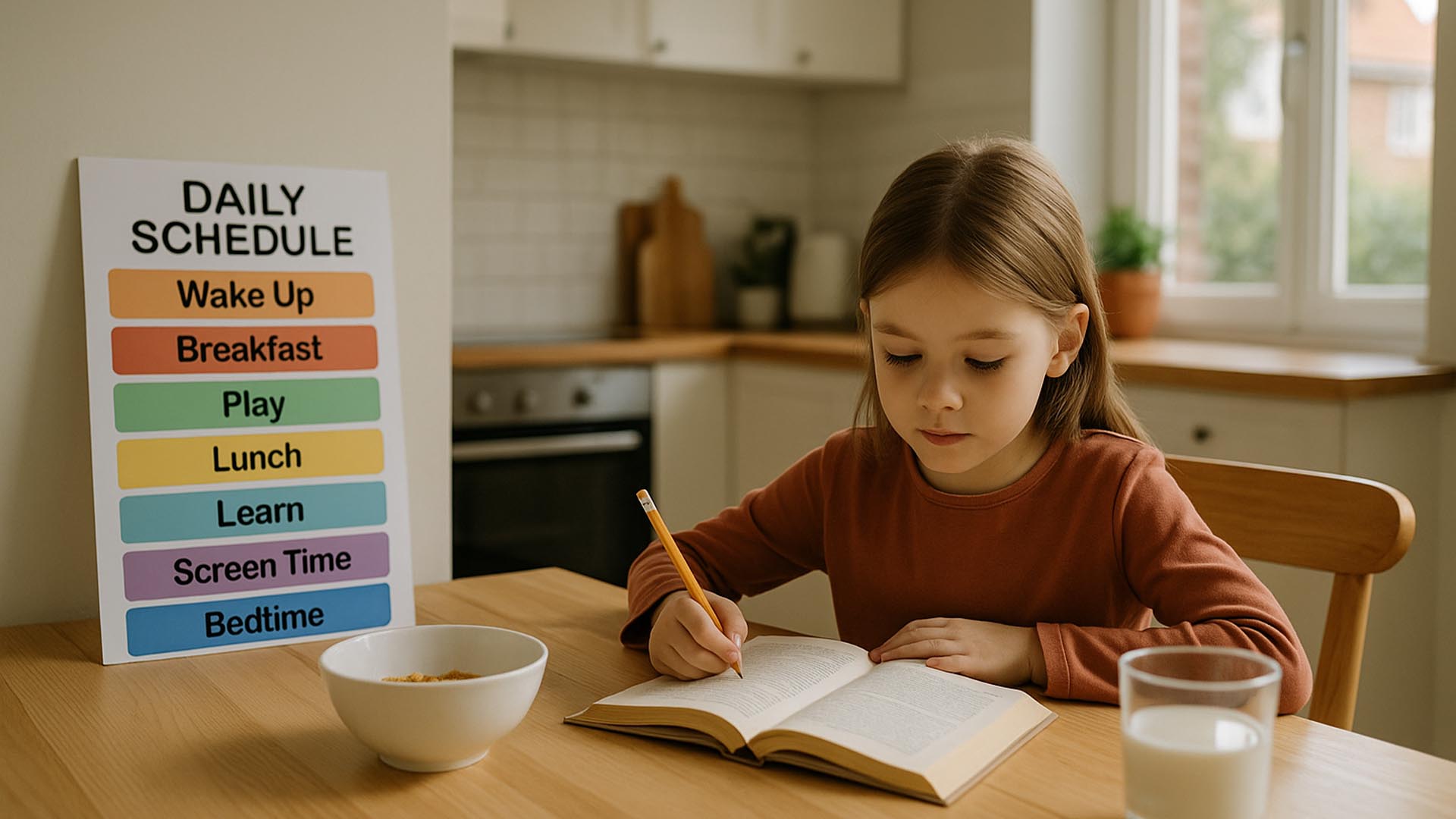

Why Routines Matter for How Children Learn
Children learn best in structured environments. Predictability lowers stress and gives the brain space to focus on exploration, memory and problem solving.
Harvard University’s Center on the Developing Child explains that routines strengthen the architecture of the developing brain by helping children anticipate what comes next. This predictability forms the foundation for executive function — the mental processes required for learning, planning, attention and self-control.
Studies in developmental psychology also show that children with stable daily rhythms demonstrate stronger language development, better emotional regulation and more resilience during stressful situations. These benefits appear across cultures and family structures.
How Routines Improve Memory, Focus and Independence
Children thrive when activities follow a recognizable pattern: waking up, eating, playing, resting, learning and winding down.
Predictable patterns allow the brain to:
- Reduce cognitive load (less energy wasted on uncertainty)
- Strengthen neural pathways for memory
- Increase sustained attention
- Support confidence and autonomy
The American Academy of Pediatrics notes that children who follow routines at home show better behavior and better academic outcomes at school because routines reduce decision fatigue and increase feelings of control.
Why Children Feel Safer With Predictable Patterns
Routines don’t just organize the day; they organize emotions.
When kids know what happens next, the world feels less overwhelming. A consistent daily flow becomes an anchor in moments of uncertainty — starting school, changes at home, or adjusting to new stages of development.
The Greater Good Science Center at UC Berkeley highlights that routines support emotional security by signaling belonging, continuity and stability. Children internalize this structure and begin to manage transitions more smoothly on their own.
Examples of Simple Learning Routines That Work
Parents don’t need elaborate schedules. Small repeated actions shape powerful habits. Here are practical examples:
Morning routines that set the tone
- Wake up at the same time daily
- Light stretching or movement
- A short conversation about the plan for the day
- A healthy breakfast with limited screens
Afternoon routines that build learning flow
- A “focus time” block for homework or creative activities
- Short breaks every 20 minutes
- Independent reading before playtime
- A consistent snack time
Evening routines for emotional regulation
- A calming activity (drawing, crafting, music)
- Limited screen use 1 hour before bed
- Two-step bedtime (bath, reading)
- Discussing one good moment from the day
These small sequences teach kids time management and self-regulation — both essential for learning.
The Science Behind Why Repetition Builds Skills
Repetition wires the brain.
When children perform the same action repeatedly — reading at the same hour, cleaning up toys after play, practicing letters every day — neural pathways strengthen.
This is supported by decades of research in neuroplasticity, including findings from the University of California and other cognitive development centers.
Repetition also helps kids:
- Master new vocabulary
- Understand cause-and-effect
- Improve motor skills
- Develop task-completion habits
How Parents Can Introduce New Routines Without Stress
Adding structure doesn’t mean becoming rigid. The key is gentle consistency.
Useful steps include:
- Start with one small routine (e.g., reading after dinner)
- Use visual cues for younger kids (pictures, charts)
- Keep transitions short and calm
- Celebrate small successes
- Model routines by following your own
When children see adults perform consistent behaviors, they naturally copy them. Modeling is one of the strongest forms of non-verbal teaching.
Routines and Screen Time: Finding a Healthy Balance
Screens aren’t harmful by default — only unstructured usage is.
The American Academy of Pediatrics recommends household “media plans” to create boundaries around screens without demonizing them.
A balanced routine might include:
- Screens only after homework
- No devices during meals
- Shared viewing instead of isolated scrolling
- Tech-free hour before bedtime
These guidelines help kids understand limits and prevent overstimulation, sleep disruption or dependence on passive entertainment.
How Routines Support Learning in Different Age Groups
Toddlers: predictability helps reduce tantrums and increases cooperation.
Preschoolers: routines support early literacy, language growth and independence.
Early school-age: routines strengthen homework habits and daily responsibility.
Teens: although they resist structure, routines reduce anxiety and improve academic performance.
Child development research consistently shows that routines work even when kids seem uninterested in them — the stability still benefits their brain and emotions.
When Routines Need Adjustment
Families change, and routines should adapt. Signs that a routine needs updating:
- Increased conflict during transitions
- Overcomplicated schedules
- Loss of interest or motivation
- New developmental needs (school changes, puberty, anxiety spikes)
Adjusting routines teaches flexibility — a skill as valuable as consistency.
Why Learning Routines Build Lifelong Skills
Children who grow up with routines typically develop:
- Time-management skills
- Better emotional regulation
- Stronger academic focus
- More independence in decision-making
- A healthy relationship with structure and rest
These are essential for adulthood — work habits, family life, and self-discipline all grow from early daily patterns.
Sources
- https://developingchild.harvard.edu/resources/three-early-childhood-development-principles-to-improve-outcomes/
- https://www.healthychildren.org/English/family-life/family-dynamics/communication-discipline/Pages/Building-Resilience.aspx
- https://greatergood.berkeley.edu/article/item/how_rituals_make_us_happier
- https://www.healthychildren.org/English/media/Pages/default.aspx



0 Comments