


Look up at the night sky, and you'll see a twinkling tapestry of stars. But did you know that our own home, Earth, is part of an incredible neighborhood called the Solar System?
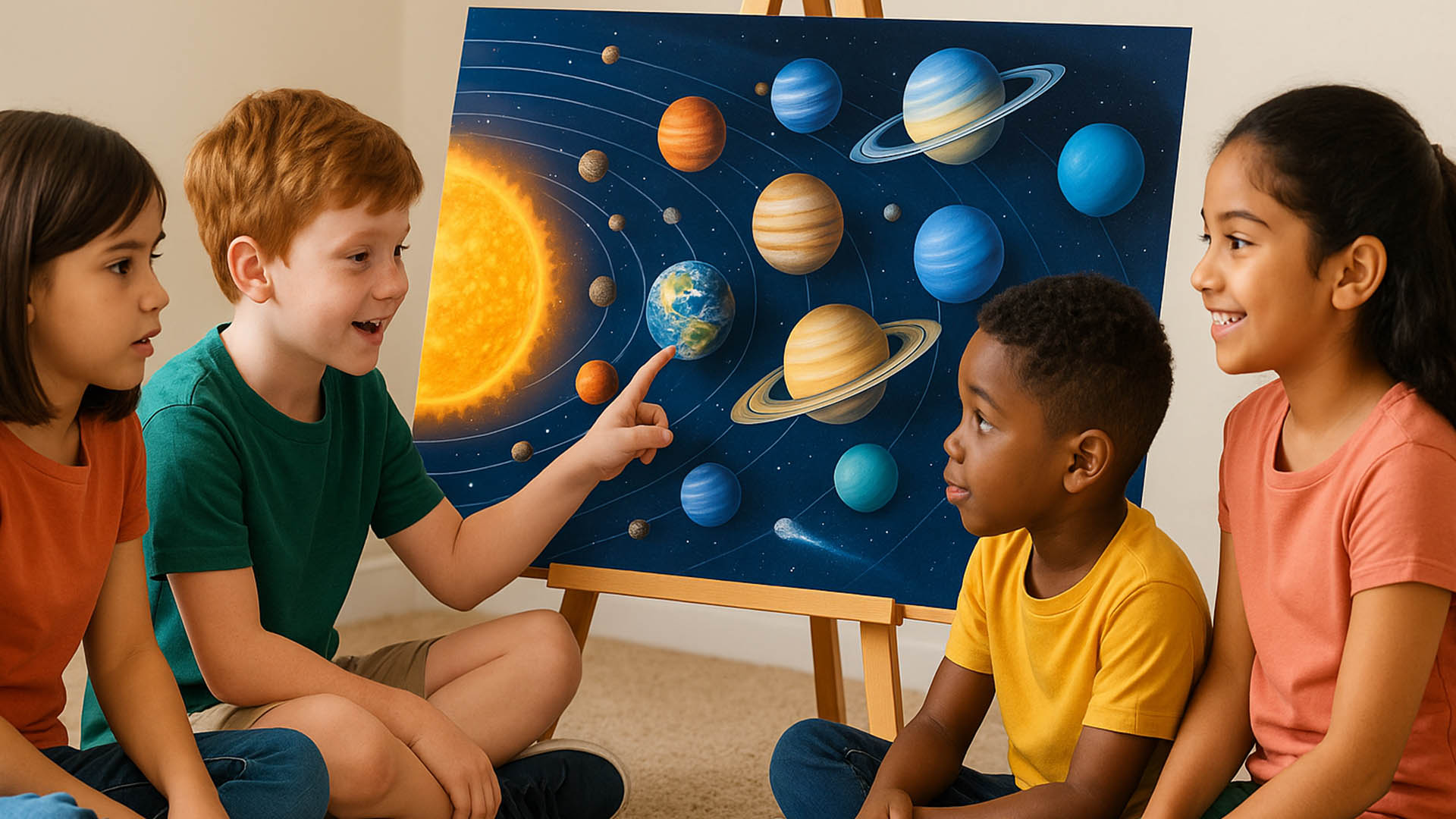
It's a giant family that includes the Sun, eight amazing planets, dwarf planets, moons, asteroids, and comets, all dancing around each other in space! Let's blast off on an adventure to explore our cosmic backyard and discover some out-of-this-world facts!
Main Content
What is the Solar System?
Our Solar System is made up of the Sun, which is a huge star, and everything that orbits, or travels around, it. This includes the eight planets: Mercury, Venus, Earth, Mars, Jupiter, Saturn, Uranus, and Neptune [1].
It also has smaller objects like dwarf planets (Pluto is one!), hundreds of moons, and countless asteroids and comets [2].
The Sun's powerful gravity keeps all these celestial bodies in their paths, like an invisible string pulling them along.
The Sun: Our Star
At the very center of our Solar System is the Sun, a gigantic ball of hot, glowing gas. It's so big that one million Earths could fit inside it! [3] The Sun gives us light and heat, which are essential for life on Earth. Without the Sun, our planet would be a dark, frozen place.
The Eight Planets: A Quick Tour
Let's take a quick tour of our planetary neighbors, starting from the closest to the Sun:
- Mercury: The smallest planet and the closest to the Sun. It's super fast, zipping around the Sun in just 88 Earth days!
- Venus: Often called Earth's "sister planet" because it's similar in size, but it's incredibly hot with a thick, toxic atmosphere. It's even hotter than Mercury!
- Earth: Our beautiful home planet, the only one known to have liquid water and life. It's often called the "Blue Planet" because of its oceans.
- Mars: The "Red Planet," famous for its reddish color and polar ice caps. Scientists are very interested in Mars because it might have once had conditions suitable for life.
- Jupiter: The largest planet in our Solar System, so big that all the other planets could fit inside it! It's a gas giant with a famous Great Red Spot, which is actually a giant storm bigger than Earth [1].
- Saturn: Known for its stunning, icy rings, which are made of billions of pieces of rock and ice. Saturn is another gas giant and has many moons.
- Uranus: An ice giant that spins on its side, making it look like it's rolling through space!
- Neptune: The farthest planet from the Sun and a cold, dark ice giant with strong winds [1].
Moons, Asteroids, and Comets
Our Solar System is also home to many other fascinating objects:
- Moons: Many planets have natural satellites called moons. Earth has one, but Jupiter and Saturn have dozens each!
- Asteroids: These are rocky, airless worlds that are too small to be called planets. Most of them orbit the Sun in a region between Mars and Jupiter called the asteroid belt.
- Comets: Often called "dirty snowballs," comets are icy bodies that release gas and dust, forming a beautiful tail as they get closer to the Sun [4].
How Big is Our Solar System?
The Solar System is truly enormous! It stretches far beyond Neptune, including the Kuiper Belt (a region of icy bodies where dwarf planets like Pluto live) and the distant Oort Cloud, which is thought to be the home of many comets [4]. It takes light hours to travel from one end to the other!
Q&A for Kids
Q: What is the hottest planet in our Solar System?
A: Venus is the hottest planet, even though Mercury is closer to the Sun. This is because Venus has a thick atmosphere that traps heat, creating a super-hot greenhouse effect.
Q: Why is Earth special?
A: Earth is incredibly special because it has liquid water, an atmosphere with oxygen, and just the right temperature to support life. It's the only planet where plants, animals, and humans can thrive!
Q: Can we visit other planets?
A: While humans have only traveled to the Moon, robotic spacecraft have explored almost all the planets and many other objects in our Solar System. These amazing robots send back pictures and data, helping us learn more about space without having to go there ourselves!
Sources
[1] National Geographic Kids. (n.d.). Passport to Space. Retrieved from https://kids.nationalgeographic.com/space
[2] NASA Space Place. (n.d.). Solar System. Retrieved from https://spaceplace.nasa.gov/menu/solar-system/
[3] Learning Resources. (2024, March 21). Interesting Space Facts for Kids. Retrieved from https://www.learningresources.co.uk/blog/space-facts-for-kids/
[4] Only Dinosaurs. (n.d.). Top 25 Dinosaur Facts For Kids (Updated). Retrieved from https://onlydinosaurs.com/top-25-dinosaur-facts-for-kids/ (Note: This source was used for general information on astronomical objects, not specifically dinosaurs, as it was a broad fact-checking source used previously.)



0 Comments