



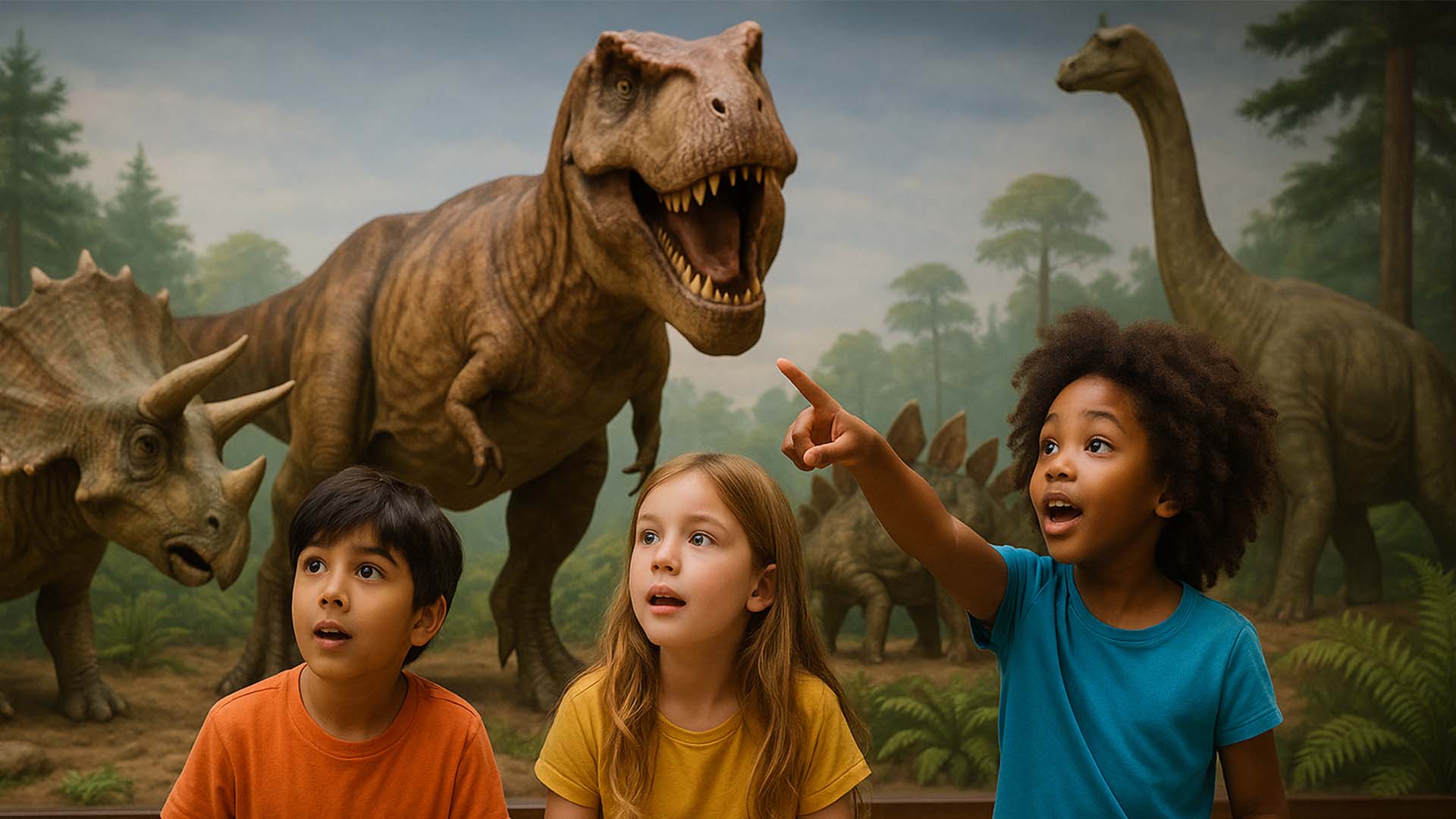

Imagine a time when giant creatures roamed the Earth, long before humans existed! These incredible animals were called dinosaurs, and their world was full of adventure and mystery. From the mighty Tyrannosaurus Rex with its huge teeth to the gentle long-necked Brachiosaurus, dinosaurs came in all shapes and sizes.
For millions of years, they were the kings and queens of our planet. Even though they lived so long ago, we can still learn so much about them through fossils and scientific discoveries. Get ready to travel back in time with us and explore the amazing world of dinosaurs!
What Exactly Were Dinosaurs?
Dinosaurs were a group of reptiles that lived on Earth for over 165 million years, during a time called the Mesozoic Era. [1] This era is often divided into three periods: the Triassic, Jurassic, and Cretaceous periods. Dinosaurs were incredibly diverse, meaning there were many different kinds of them.
Some walked on two legs, some on four. Some ate plants (herbivores), some ate meat (carnivores), and some ate both (omnivores). They ranged in size from as small as a chicken to as large as a blue whale!
Famous Dinosaurs You Should Know
Let's meet some of the most famous dinosaurs:
Tyrannosaurus Rex (T-Rex): This fearsome carnivore is one of the most well-known dinosaurs. With its powerful jaws and sharp teeth, T-Rex was a top predator. It walked on two strong legs and had tiny arms. [2]
Triceratops: Easily recognized by its three horns and large bony frill, Triceratops was a plant-eating dinosaur. Its frill might have been used for defense against predators like T-Rex or for attracting mates. [3]
Stegosaurus: This herbivore had distinctive large, bony plates along its back and a spiked tail. The plates might have helped regulate its body temperature or served as a display. Its spiked tail was definitely for defense! [4]
Brachiosaurus: One of the tallest and heaviest dinosaurs, Brachiosaurus was a long-necked plant-eater. It could reach high into trees to munch on leaves, much like a modern-day giraffe. [5]
How Do We Know About Dinosaurs?
Even though dinosaurs lived millions of years ago, scientists know a lot about them thanks to fossils. Fossils are the preserved remains or traces of ancient life, like bones, teeth, footprints, or even skin impressions, that have turned into rock over time. [6] Paleontologists are scientists who study fossils to learn about dinosaurs and other prehistoric life.
They carefully dig up fossils, clean them, and then study them to understand how dinosaurs lived, what they ate, and how they moved.
Why Did Dinosaurs Disappear?
About 66 million years ago, at the end of the Cretaceous period, most dinosaurs suddenly disappeared. Scientists believe a giant asteroid crashed into Earth, causing massive changes to the climate. [7]
This event led to widespread destruction, blocking out the sun, and making it impossible for many plants and animals, including most dinosaurs, to survive. However, not all dinosaurs vanished! Some smaller, feathered dinosaurs evolved into the birds we see today. So, next time you see a bird, remember you're looking at a distant relative of a T-Rex!
Q&A About Dinosaurs
Q1: What was the Mesozoic Era?
A1: The Mesozoic Era was a long period of time, over 165 million years, when dinosaurs lived on Earth. It is divided into the Triassic, Jurassic, and Cretaceous periods.
Q2: What did T-Rex eat?
A2: The Tyrannosaurus Rex was a carnivore, which means it ate meat. It was a powerful predator with sharp teeth.
Q3: How do scientists learn about dinosaurs?
A3: Scientists called paleontologists learn about dinosaurs by studying fossils, which are the preserved remains or traces of ancient life like bones and footprints.
Q4: Why did most dinosaurs disappear?
A4: Most dinosaurs disappeared about 66 million years ago, likely due to a giant asteroid crashing into Earth, which caused huge changes to the climate and made it impossible for many species to survive.
Sources
[1] American Museum of Natural History. (n.d.). Dinosaur Facts. Retrieved from https://www.amnh.org/dinosaurs/dinosaur-facts
[2] National Geographic Kids. (n.d.). Tyrannosaurus Rex. Retrieved from https://kids.nationalgeographic.com/animals/prehistoric/tyrannosaurus-rex
[3] National Geographic Kids. (n.d.). Triceratops. Retrieved from https://kids.nationalgeographic.com/animals/prehistoric/triceratops
[4] National Geographic Kids. (n.d.). Stegosaurus. Retrieved from https://kids.nationalgeographic.com/animals/prehistoric/stegosaurus
[5] National Geographic Kids. (n.d.). Brachiosaurus. Retrieved from https://kids.nationalgeographic.com/animals/prehistoric/brachiosaurus
[6] U.S. Geological Survey. (n.d.). Mesozoic. Retrieved from https://www.usgs.gov/youth-and-education-in-science/mesozoic
[7] Natural History Museum. (n.d.). Why did the dinosaurs die out?. Retrieved from https://www.nhm.ac.uk/discover/why-did-dinosaurs-die-out.html



0 Comments