




Why Everyday Moments Matter More Than We Think
Children don’t learn only in school, during homework or with worksheets. They learn all day long, through small, natural moments that shape how their brains grow and how they understand the world. Harvard’s Center on the Developing Child explains that simple, repeated interactions—predictable routines, conversations, problem-solving moments—build the neural architecture children need for self-control, memory and logical thinking.
Everyday learning moments teach the skills that matter most:
- focusing attention
- understanding instructions
- solving problems
- regulating emotions
- managing transitions
- building independence
These are known as executive function skills, and they develop through practice, not lectures.
Routines as the Foundation for Learning
A stable daily rhythm gives structure to the brain. When children know what to expect, their stress levels drop, and their curiosity increases. Predictability frees cognitive space — instead of worrying about “what comes next?”, the brain can focus on exploring and learning.
Research from HealthyChildren.org notes that children in consistent routines show better emotional regulation and stronger academic performance later on. Routines act as invisible “scaffolding” that supports learning.
Useful daily routine learning moments:
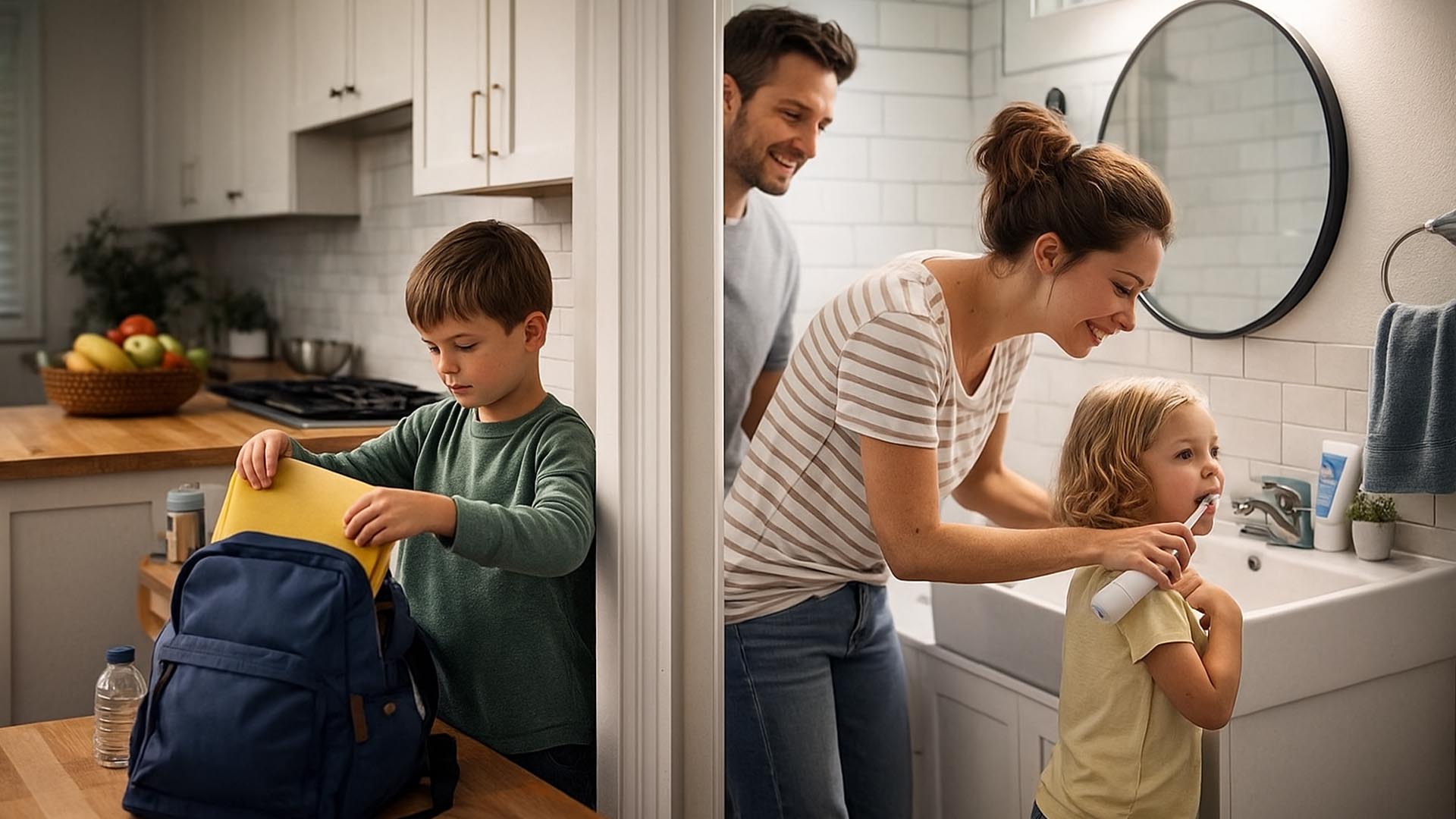
- Morning ritual (getting dressed, brushing teeth, preparing the backpack)
- Snack and meal rituals (setting the table, pouring water, cleaning up)
- After-school transitions (snack → quiet time → play)
- Pre-bed routines (bath → story → lights out)
Each of these builds sequencing skills, memory and responsibility.
How Household Activities Become Learning Tools
Parents often underestimate how much children learn from simple responsibilities. Everyday activities teach children how to plan, persist and solve problems.
Examples:
- Sorting laundry → teaches categorization and visual discrimination
- Tidy-up time → builds task completion and organization skills
- Cooking with parents → mixes math (measuring), reading (recipes), science (transforming ingredients)
- Preparing the backpack → develops independence and planning
- Feeding a pet → teaches responsibility, empathy and routine
RaisingChildren.net.au highlights that kids learn best through “learning in everyday life”—activities connected to their world, not artificial tasks.
Conversations That Build Thinking
Language is the engine of learning. Every conversation with a child is a teaching moment.
Powerful parent questions include:
- “How do you think we can solve this?”
- “What do you notice about that?”
- “What should we do first?”
- “Why do you think that happened?”
- “What could we try next?”
These questions build reasoning and problem-solving by turning children into active thinkers, not passive receivers.
Parents can use micro-moments:
- In the car
- While walking
- While waiting in line
- During meals
- Before bedtime
Each conversation deposits a “learning seed” in the child’s mind.
How Play Strengthens Learning Naturally
Children learn deeply through play — not just academic concepts, but emotional and cognitive skills.
Learning benefits of play include:
- Planning and decision-making (choosing roles, building structures)
- Creativity (inventing scenarios)
- Negotiation and cooperation (sharing roles and toys)
- Motor development (running, stacking, handling objects)
- Early math and science (counting blocks, testing balance, sorting shapes)
Play is not “just fun”—it is rich, self-driven learning.
How to Turn Any Day into a Learning Day
Parents do not need complicated setups. A few small habits transform an ordinary day:
1. Narrate the world.
Describe what you see, hear, feel, and do. (“I’m slicing the apples into small pieces. What shape do you see?”)
2. Encourage decision-making.
Offer choices with limits. (“Do you want the blue cup or the green cup?”)
3. Practice sequencing.
Ask kids to explain steps. (“What do we do before brushing teeth?”)
4. Use time markers.
Help kids understand transitions: “Two more minutes, then we clean up.”
5. Create mini-challenges.
“Can you find three round objects?”
“Can you build a tower taller than your hand?”
6. Celebrate effort, not perfection.
This builds resilience and growth mindset.
The Power of “Wait Time”
Parents often jump to help too quickly. When a child struggles, pausing for 10–15 seconds gives their brain time to think. This simple technique supports problem-solving and confidence.
Let children wrestle a little with challenges — zippers, puzzles, putting on shoes, cleaning up.
This is how independence grows.
When Everyday Learning Moments Become Too Much
Learning should be natural, not pressured. Signs of overload include:
- frustration
- irritability
- avoidance
- shutting down
- asking repeatedly for help
When this happens, reduce demands and focus on connection and calm instead of problem-solving.
Building Lifelong Skills — One Small Moment at a Time
Daily micro-experiences shape who children become. They may forget the details, but their brains remember the patterns:
- “I can try.”
- “I can solve problems.”
- “I know what comes next.”
- “I can manage my emotions.”
- “I am capable and trusted.”
Every small moment — brushing teeth, preparing a snack, asking a question — builds the foundation for lifelong learning, confidence and independence.
Sources
https://developingchild.harvard.edu/resource-guides/guide-executive-function/



0 Comments