



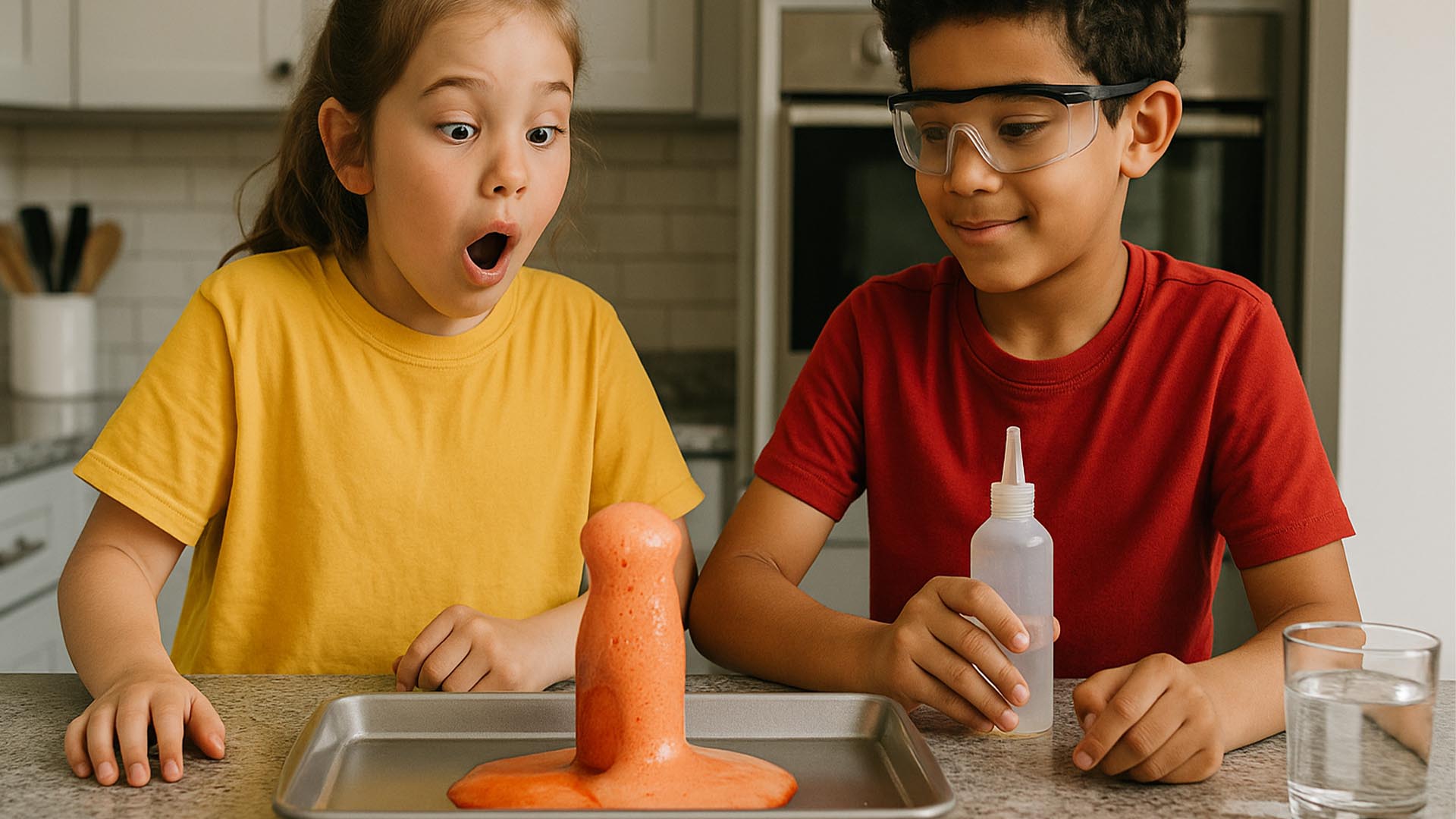
Did you know that your kitchen is actually a super cool science lab? You don't need fancy equipment to be a brilliant scientist! With just a few common household items, you and your parents can explore the amazing world of chemistry and physics.
These experiments are safe, easy, and incredibly fun, proving that science is all around us! Get your lab coats (or just a t-shirt you don't mind getting messy) and let's start experimenting!
"Science is simply the word we use to describe a method of organizing our curiosity." - Attributed to Stephen Hawking
1. The Amazing Baking Soda Volcano
This classic experiment is a fantastic way to see a chemical reaction in action—and it's super messy!
Materials
•A small plastic bottle or glass jar.
•Baking soda (about 2 tablespoons).
•Vinegar (about 1/2 cup).
•Dish soap (a squirt).
•Red food coloring (a few drops, for that lava look!).
•A tray or plate to catch the eruption.
Instructions
1.Place your bottle on the tray.
2.Add the baking soda, dish soap, and food coloring into the bottle.
3.Pour the vinegar into the bottle and stand back!
The Science Behind It
This is a chemical reaction between an acid (vinegar) and a base (baking soda). When they mix, they create a gas called carbon dioxide. The gas builds up quickly inside the bottle, and the dish soap traps the gas bubbles, making a foamy, bubbly eruption that looks just like a volcano!
2. Dancing Raisins
Can you make a raisin dance? Yes, you can! This experiment teaches you all about density and buoyancy.
Materials
•A tall, clear glass.
•Clear, fizzy soda (like sparkling water or lemonade).
•A handful of raisins.
Instructions
1.Fill the glass about three-quarters full with the fizzy soda.
2.Drop 5-6 raisins into the glass.
3.Watch closely! The raisins will sink, but soon they will start to float up and down like they are dancing.
The Science Behind It
Fizzy drinks have lots of carbon dioxide gas bubbles. When the raisins sink, the tiny bubbles stick to the rough surface of the raisins. As more bubbles stick, they act like little life jackets, making the raisin buoyant (lighter than the liquid) and floating it to the top. When the bubbles pop at the surface, the raisin becomes heavy again and sinks, only to collect more bubbles and start the dance all over!
3. Magic Milk Painting
This is a beautiful, colorful experiment that shows how soap breaks down fat.
Materials
•A shallow dish or plate.
•Milk (whole milk works best because it has more fat).
•Food coloring (at least 3 different colors).
•Dish soap.
•Cotton swabs.
Instructions
1.Pour enough milk into the dish to cover the bottom.
2.Add drops of food coloring to the milk. Place them near the center.
3.Dip one end of a cotton swab into the dish soap.
4.Touch the soapy end of the swab to the milk (try to hold it in one spot) and watch the colors explode and swirl!
The Science Behind It
Milk has fat in it. Dish soap is a degreaser, meaning it is designed to break down fat. When the soap touches the milk, it rushes to break up the fat molecules. This movement of the fat causes the colors to swirl and mix in a beautiful, colorful pattern. The reaction stops when all the fat has been broken down.
Q&A for Header
Q: What makes the baking soda volcano erupt? A: The eruption is caused by a chemical reaction between the acid (vinegar) and the base (baking soda), which creates carbon dioxide gas. The gas builds up and pushes the foamy liquid out of the container.
Q: Why do the raisins dance in the fizzy water? A: The raisins dance because carbon dioxide bubbles from the fizzy water stick to them, making them light enough to float. When the bubbles pop at the surface, the raisins sink again to collect new bubbles.
Q: Is it safe to do these experiments without an adult? A: No. You should always have a parent or trusted adult with you when doing any science experiment, especially when using ingredients like vinegar or dish soap.
Sources
•Good Housekeeping: 45 Easy Science Experiments for Kids
•We Are Teachers: 75 Easy Science Experiments Using Materials You Already Have


0 Comments