



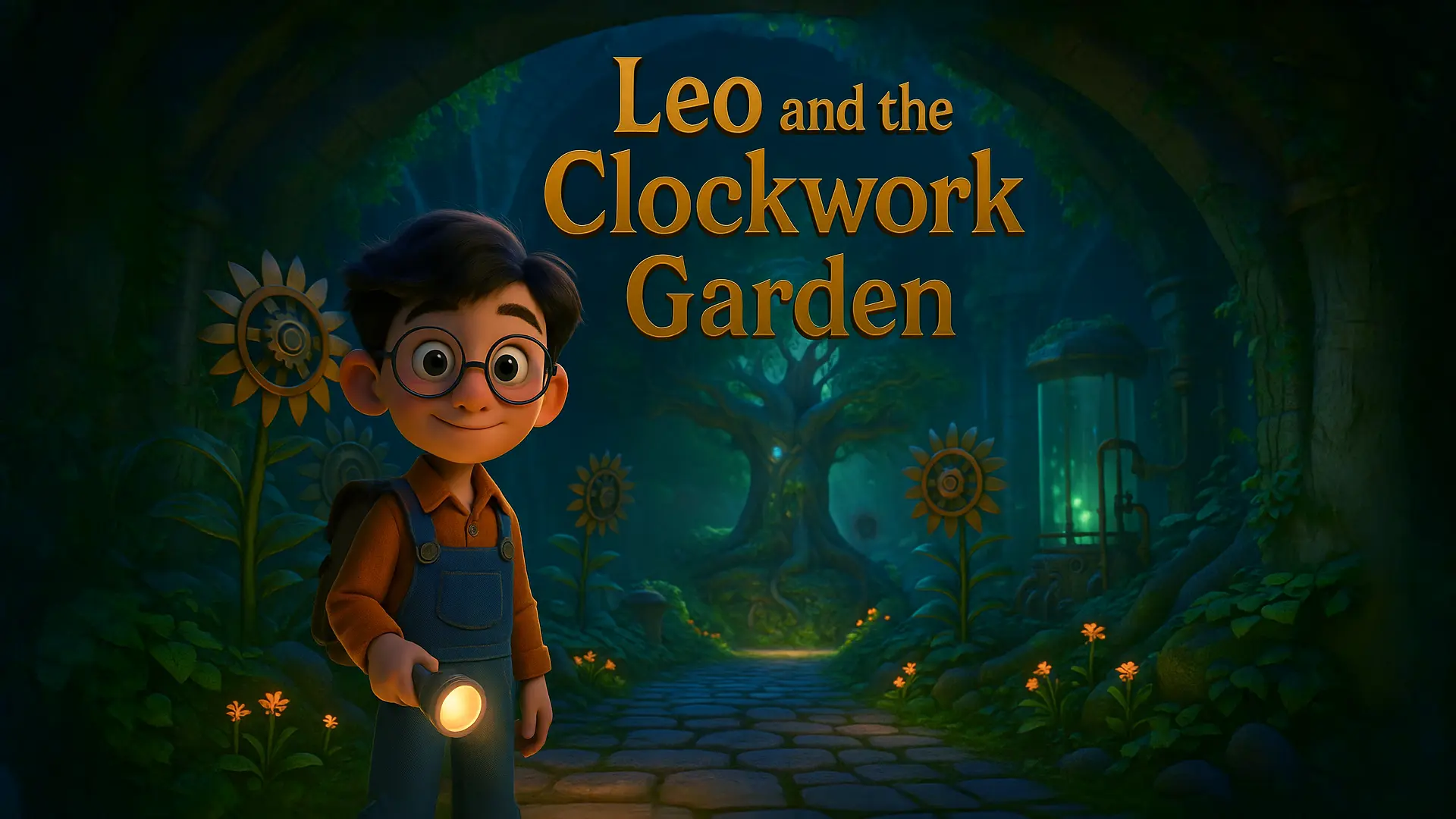

In the small town of Windmere, nestled between green hills and cloudy skies, there stood an old library with stained-glass windows and creaky wooden floors.
Most children rushed past it on their way to the playground or the ice cream shop, but not Leo.
Leo loved the library. He loved the smell of old paper and the quiet that felt like a whisper. But what he loved most were the blueprints — dusty rolls of yellowed parchment hidden on the top floor, filled with drawings of strange inventions and forgotten machines.
One rainy afternoon, as thunder echoed in the hills, Leo noticed something unusual. Beneath a loose floorboard in the back of the blueprint room, he found a metal ring.
He pulled it gently. With a groan and a click, the floor shifted and revealed a small trapdoor with a brass handle.
Without a second thought, Leo grabbed his flashlight and climbed down.
The Garden Beneath
What he found was not darkness or dust, but wonder.
A vast underground space stretched before him, its stone walls covered in ivy and moss. But it wasn’t nature that had built this place — it was gears, levers, and pulleys.
Giant bronze sunflowers with ticking petals lined a cobblestone path. Mechanical vines twisted around tall glass tubes filled with glowing liquid.
At the center stood a tree — part wood, part metal — with silver leaves that shimmered even in the dim light. It was silent. Still. As if asleep.
At its base, a brass plaque read:
“The Clockwork Garden — where nature and invention bloom together. Restore us.”
Fixing the Forgotten
Leo was breathless. He spent the next several days sneaking into the garden every afternoon. With his toolkit and blueprint books, he began cleaning the gears, oiling the hinges, and realigning the solar panels hidden in the ceiling above.
Every time he fixed a part, something changed.
A mechanical bee buzzed awake and flew from one clockwork flower to another. A fountain burbled to life with sparkling water. The glowing tubes began to pulse, sending warmth through the vines.
But the tree at the center remained still.
Leo was puzzled. He checked every gear, every wire. Then, one night, as he sat beside the silent tree, he noticed something: the roots were tangled in a thick blanket of dust and dried leaves.
He knelt, cleared it gently with his hands, and uncovered something surprising — seeds. Tiny metal seeds with soft green shoots.
The tree didn’t need fixing. It needed care.
Growth Takes Time
For the next week, Leo visited every day, watering the roots and humming softly while he worked. He even brought sunlight in through a mirror contraption he built from old desk lamps and polished spoons.
One morning, just as he arrived, the tree let out a soft chime. The branches shifted, leaves fluttered, and a new flower bloomed — part gear, part petal — in the palm of Leo’s hand.
The garden was awake.
A Garden for Everyone
Leo wanted to keep it secret forever. But the beauty of the Clockwork Garden wasn’t meant for just one person. So, with the librarian’s help, he wrote a guidebook and opened the trapdoor to the public.
Children came, wide-eyed and curious. They planted new seeds, built tiny machines, and painted the walls with stories. Every visitor added something to the garden — a hummingbird drone, a wind-powered lily, a poem carved into copper leaves.
Leo became its Keeper, not just of gears and tools, but of the balance between imagination and care.
The Message of the Garden
The Clockwork Garden taught children that creativity isn’t just about making things — it’s about growing them with patience. It showed that technology and nature don’t have to compete — they can bloom side by side when treated with respect.
And every time a child looked up in wonder at the silver-leaved tree and whispered, “Wow,” Leo smiled, knowing the garden was doing exactly what it was meant to do.
Moral of the Story:
Imagination can build anything — but true growth takes time, care, and heart. When we respect nature and technology equally, we plant the seeds of a better future.



0 Comments